

What Is a Rent-Back Agreement and Should San Diego Buyers Offer One?
What Is a Seller Rent-Back Agreement?
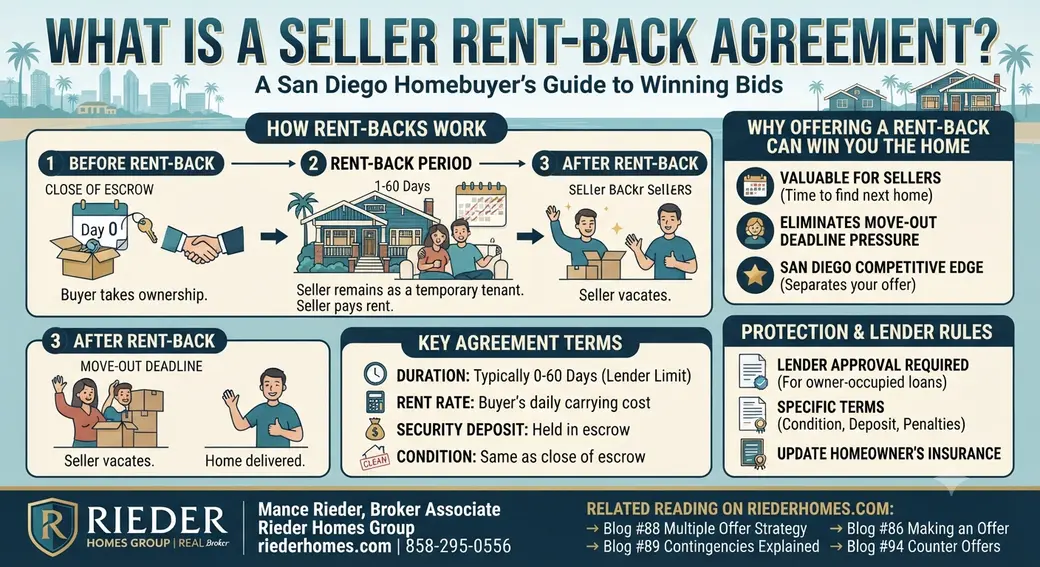
A seller rent-back — also called a seller leaseback — is an arrangement where the buyer takes ownership of the property at close of escrow but allows the seller to remain in the home as a temporary tenant for a defined period after closing. The seller pays rent to the buyer during this period. Rent-backs are commonly requested by sellers who have not yet found or closed on their next home.
Why Offering a Rent-Back Can Win You the Home
For many San Diego sellers — particularly those selling a primary residence and buying simultaneously — the ability to stay in their home for 30 to 60 days after closing is enormously valuable. It eliminates the pressure of a hard move-out deadline and gives them time to close on their purchase without rushing. Offering a rent-back costs you little and can be the single factor that separates your offer from competing bids.
How Rent-Backs Are Structured
- Duration: Typically 0 to 60 days — lenders generally limit rent-backs to 60 days for owner-occupied loans
- Rent rate: Typically calculated as the buyer's daily carrying cost — mortgage, taxes, and insurance divided by 30
- Security deposit: A refundable deposit held in escrow for property damage
- Condition: Property must be returned in the same condition as at close of escrow
Lender Requirements for Rent-Backs
If you are financing your purchase, your lender must approve the rent-back. Most conventional lenders allow rent-backs up to 60 days — because lenders classify any rent-back beyond 60 days as a non-owner-occupied loan requiring a higher down payment. Confirm rent-back length with your lender before including one in your offer.
Protecting Yourself in a Rent-Back
While rent-backs are generally low-risk, protect yourself by ensuring the rent-back agreement specifies the condition the property must be returned in, the rent rate and security deposit, and a clear move-out date with penalty provisions for holdover. Your homeowner's insurance should be updated to reflect that you are the owner but the property is temporarily tenant-occupied.
Related Reading on RiederHomes.com:
→ Blog #88: Multiple Offer Strategy
→ Blog #86: Making an Offer
→ Blog #89: Contingencies Explained
→ Blog #94: Counter Offers
— Mance Rieder, Broker Associate | Rieder Homes Group | REAL Broker | riederhomes.com | 858-295-0556
Categories
- All Blogs (232)
- 55+ Community (1)
- Aging (1)
- Boosting Your Home's Value (5)
- Buying (116)
- downsizing (1)
- Family & Caregiving (1)
- Financial Planning (1)
- MCAS (1)
- Military Families (1)
- Miramar (1)
- Poway (1)
- Rancho Peñasquitos (1)
- San Diego Real Estate (1)
- Selling (99)
- Selling Your Home (1)
- single story home (1)
Recent Posts